
Early planting, stronger yields: 50 years of ESPS in southern soybeans
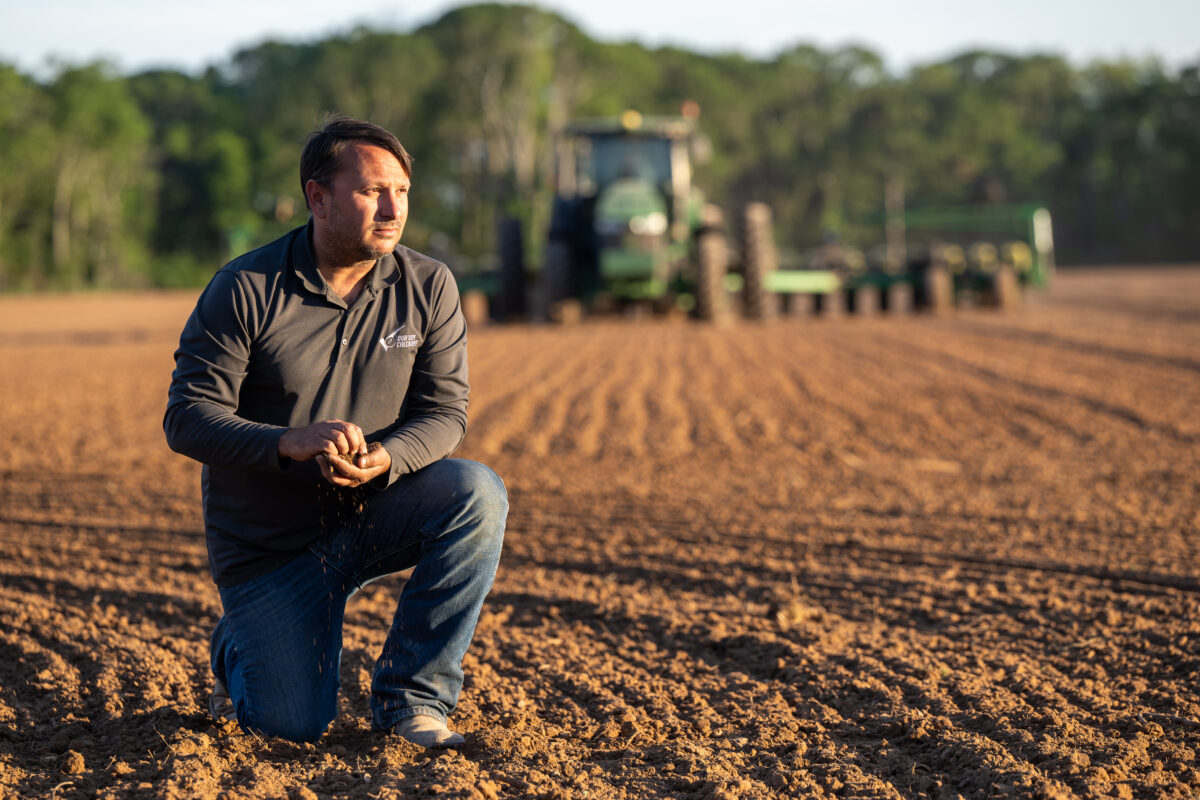
Even as this winter’s snow and cold persist, farmers’ thoughts are turning to spring planting and decisions that will shape the year ahead.
For United Soybean Board Director Joey Boudreaux, spring planting is top of mind.
On Boudreaux’s place in Louisiana and on other farms throughout the South, however, soybean planting is done just a little bit differently – and often earlier – than in most other soybean-growing regions.
About ten years ago, Boudreaux and other famers in his area changed some of their conventional practices, including planting, as they as they began seeing more consistent yields, fewer pest issues, and better timing at harvest. And those benefits are big ones – especially yield stability and reduced pest and disease pressure. These advantages translate into improved farm resilience, which reduces risk and helps operations stay profitable year to year.
But what seems like a Southern practice that evolved out of necessity is actually part of a system developed 50 years ago.
Back in the 1970s, conventional May- to June-planted soybeans often produced erratic yields and low profitability due to weather and disease pressure in the southern United States. At that time, the recommended production practice in that region was to plant maturity Group VI, VII, and VIII from May 15 until June 30.
Agronomist Dan Bradshaw was listening to a presentation on double cropping soybeans in central Florida in 1976 when he realized that early planted Midwest soybean varieties might be the answer to many of the production problems that producers were seeing in South Texas. If the proper variety of soybean could be planted in late March and produce a crop in Gainesville, Florida, he wondered, why couldn’t a system be developed to work along the upper Gulf Coast of Texas? Bradshaw and his team began research and small-scale testing in 1977, calling this method the Early Soybean Production System (ESPS).
“The whole ESPS started in my mind as a single seed. I did not know what it would grow into,” recalls Bradshaw. “Just that if it was real and could be proven that it would fill the need of our local farmers.”
Growers who heard of these efforts on the radio and farmer-to-farmer conversations started asking questions and discussing the concept. The early planting system interested them for several reasons: a desire for higher yields; more stable, dependable production due to early planted soybeans being able to take advantage of more favorable rainfall patterns; spreading their workload; and the potential for earlier harvest before fall rains.
The adoption of these new methods took some time, says Bradshaw. Only a few universities and extension programs accepted ESPS in the first few years and then after early adopting, farmers proved it successful. After the publication in 1998 of the “Early Soybean Production System Handbook,” funded by USB, it finally became widely accepted by others by the early 2000s. ESPS has become a widely used practice today not only on Boudreaux’s farm, but throughout the Southern states.
As growers’ and their customers’ conversations have increasingly turned to farm sustainability, ESPS is proving to be a practical management tool for improving efficiency and resilience.
Early planting, often combined with other climate-smart agricultural practices like cover cropping, can improve nitrogen efficiency and reduce input losses. Studies indicate that early planting, particularly when combined with cover crops, can decrease yield-scaled nitrogen emissions.[1] In simple terms, that means more bushels produced with fewer emissions.
Additionally, early planting, particularly when paired with other sustainability methods, also could show up in models like GREET (Greenhouse Gases, Regulated Emissions, and Energy Use in Technologies), the same lifecycle model used to evaluate agricultural feedstocks. Early planting is considered a beneficial management practice that contributes to the overall reduction of greenhouse gas emissions in the “feedstock growth/sourcing” stage of the GREET lifecycle analysis.[2]
Boudreaux has discovered that, overall, the earlier he’s able to plant his soybeans, the better. “For me, key advantages include higher yield and less insect or disease pressure,” he reports. “And if we have less disease and fewer insects, I spray less, which is economically efficient.”
Elsewhere in the South, Georgia farmer Alex Harrell has twice produced record yields over 200 bushels per acre, breaking the previous record by roughly 8%. “This demonstrates how a new generation of farmers are taking ESPS to the next step,” explains Bradshaw, “proving that by careful monitoring of the early planted crop and giving the crop what it needs, they can be making beans when there is the most sunshine for pod fill.”
Other advantages include earlier harvesting, more time without a crop in the field to perform tasks such as fall tillage or lime application, less exposure to late-season weather risks, and, says Boudreaux, sometimes even receiving a better basis at the elevator.
Weather, however, can be a limiting factor for early planting. “It’s my intention to plant my soybeans early every year, but sometimes spring rain or other weather interferes,” Boudreaux says.
Along with earlier planting, Boudreaux and his neighbors have shifted away from some of their other conventional practices, especially those related to tillage. Reduced tillage and no till have increased in popularity, as they rely more on herbicides for weed control.
“For farmers, the climate is always changing,” says Bradshaw. “They know they must learn from the past and plan for the future. ESPS gives them another tool. And the plant breeders are continually producing new varieties to meet the changing conditions.”
Although ESPS is a system, it is highly individualized – planting dates shift, varietals change, and farmers will always need to continue to do what is best for their individual operations. “These methods aren’t for everyone,” Boudreaux states. “Soybean growers do what needs to be done on a year to year basis.”
###
[1] https://www.nature.com/articles/s41893-024-01458-9#:~:text=3b).,1;%20Supplementary%20Table%201).
[2] https://www.energy.gov/sites/default/files/2025-05/45zcf-greet-user-manual-may2025.pdf
How did you like this article?
