
From Ohio fields to global markets: One farmer’s takeaways from Egypt
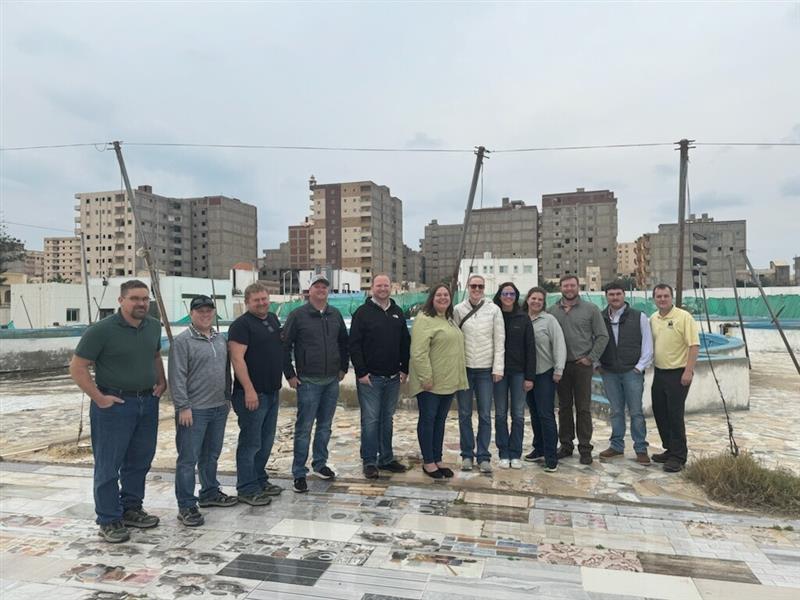
Becca Waldo with fellow See for Yourself participants in Egypt.
Of all the statistics Becca Waldo encountered during a recent “See for Yourself” trade mission to Egypt, one hit closest to home: the average Egyptian family eats meat only about once a month.
“That was really eye-opening,” she said.
For Waldo, who farms in northeast Ohio alongside her father, Soy Checkoff farmer-leader Jeff Magyar, that single fact reframed the stakes of growing U. S. soybeans.
The See for Yourself program gives farmers a firsthand look at how checkoff dollars are used to build markets overseas. In Egypt, that included a visit to the Soy Excellence Center (SEC) at WorldFish, the first SEC established in the Middle East and North Africa region.
Launched in 2019 by the U.S. Soybean Export Council (USSEC) with support from WorldFish, the center trains people in Egypt’s poultry, livestock and fish farming industries to use soybeans more effectively in feed.
A classroom 6,000 miles away
“It was really cool to see,” Waldo said, referring to the center. “I got to sit down with students at lunch and hear their backgrounds. One person worked for a hatchery 40 miles away but still came to the center through their job to learn more. Having those students go back to different industries, whether fish farming or feed milling, is something I think will help the market in Egypt grow.”
That growth is already underway. Egypt is now the fourth-largest export market for U.S. soy, driven by one of Africa’s fastest-expanding populations. Accounting for 3.3 million metric tons of imported soy at $1.4 billion, the country sources large amounts of U.S. soybeans each year that are crushed into meal for animal feed used in poultry, dairy, and fish production. ¹
Programs like the SEC help those industries raise animals more efficiently and produce more food.
“It’s not just about making food cheaper,” Waldo said. “It’s about feeding animals better feed so the person eating that food gets a better product.”
The difference you can see
At an oil processing plant, buyers explained that many companies prefer U.S. soybeans because of their color, a difference that comes down to how the beans are dried. They dry naturally in the field before harvest. In some other countries, beans are harvested earlier and run through heated dryers, which can damage them.
“Whenever you put a soybean through a dryer, you’re going to see heat damage,” Waldo said. “They get darker, and if you have too many dark beans, it can affect the final product.”
It’s about relationships
Most Ohio soybeans, including Waldo’s, move through Pacific Northwest export terminals to Asian markets. Even though her beans won’t make it to Egypt, the trade mission showed her how demand in one part of the world still shapes the market for every farmer.
One of the biggest takeaways from the trip was seeing how Soy Checkoff dollars help build long-term relationships with buyers overseas. At nearly every stop, the U.S. soybean representatives already knew the people they were meeting with.
“You could tell those relationships had been built over time,” Waldo said. “We weren’t just showing up somewhere unexpected.”
Those connections are developed through organizations like USSEC and the checkoff’s meat export partners including U.S. Meat Export Federation and USA Poultry and Egg Export Council. They work directly with companies that buy soybeans and meat products (fed U.S. soy) around the world. It’s the kind of reach that no individual farmer could build alone.
“If you took those checkoff dollars and tried to market your soybeans yourself, how far could you reach?” Waldo said.
By the time Waldo returned home to Ohio, she had a different view of the crop she plants every spring. Soybeans grown across the Midwest are part of a much larger food system that stretches across the world and seeing that system up close helped bring that connection into focus.
“Being a small-town farmer from Ohio and realizing you’re connected to world trade is pretty neat,” Waldo said. “Seeing those relationships and knowing that’s where your checkoff dollars are going — that was really reassuring.”
¹ U.S. Soy exports continued to grow in marketing year 2024/25 | United Soybean Board. USDA, Global Agricultural Trade System (GATS).
How did you like this article?
