
From South Dakota to the Nile: How Egypt’s growing appetite for protein opens doors for U.S. Soy
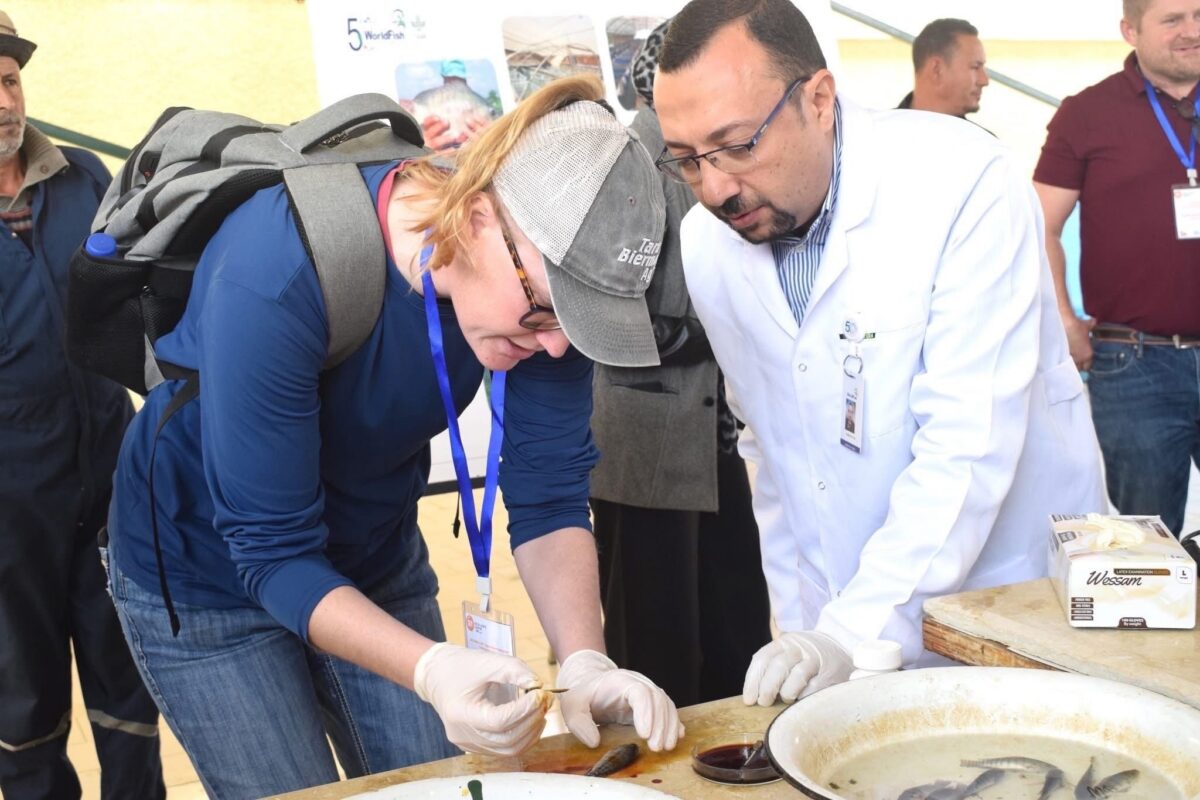
Tara Bierman tags a fingerling at WorldFish in Cairo.
When a researcher at a WorldFish facility in Cairo handed South Dakota farmer Tara Bierman a small fingerling and asked if she wanted to try tagging it, she didn’t hesitate.
“Who wouldn’t want to tag a fish?” Bierman laughed.
It was a small moment, but a telling one: a South Dakota soybean farmer standing in Egypt, learning how the beans she grows fuel a global protein economy she’d never fully seen up close. That’s exactly what the Soy Checkoff’s See for Yourself trade mission is designed to do.
Bierman, a soybean, corn, oats, and poultry farmer who also serves on the South Dakota Soybean Association board, came away from the Cairo trip with a sharper understanding of why international demand matters back home. Even when South Dakota beans don’t flow directly to a market like Egypt, building strong global partnerships and reliable customers move the pile and supports commodity prices for growers across the country.
Tracking fish, understanding markets
That connection starts with understanding how soy fits into global food systems, and for Bierman, the WorldFish facility made it tangible. The tagging process works much like livestock tracking back home. Fish are weighed, measured, and tagged at the start, then scanned again at harvest to track growth over time. “I just never thought about how you would track fish,” Bierman said. “It was pretty neat.”
But the bigger takeaway went beyond the mechanics. Seeing firsthand how central soy is to aquaculture feed and how much Egyptian buyers value the quality and consistency of U.S. soy brought the global story home. “That really stuck with me,” she said.
The four Ds: Why U.S. Soy stands out
Bierman has a straightforward framework for explaining why U.S. soy is favored in global markets: the four Ds. U.S. soybeans dry naturally in the field, which reduces damage and makes them more digestible than beans from competing origins like South America. They’re also produced without deforestation, an increasingly important distinction as buyers worldwide grow more conscious of environmental impact.
“Those four Ds help us better market U.S. soy all around the world,” Bierman said. “Egypt really appreciates that we are sustainable. It matters to them.”
A growing market with enormous potential
Now ranking as our fourth largest export market for U.S. soy, Egypt sees rising demand for protein driven by one of Africa’s fastest-expanding populations.
“Right now, the average Egyptian eats meat maybe once a month because they can only afford it once a month,” Bierman said. “The first thing you’re going to want to increase in your quality of life is your food. So, they’re going to want more protein, and in order to meet that demand, they’re going to need additional soy protein to feed poultry and fish.”
Egypt is a leader in African aquaculture and has ambitions beyond meeting domestic needs: it aims to export protein products to the European Union and the broader region. That makes Egypt ripe for expansion and a market of strategic importance for U.S. soy farmers.
Why Egypt matters to South Dakota farmers
Most soybeans from South Dakota travel to the Pacific Northwest for export, typically heading to markets in Asia rather than Egypt directly. But global demand is deeply interconnected.
“With so many soybeans to export, great global partners help everybody,” Bierman said. “As a farmer, you must think big picture and long term — any place in the world where we can export our product and build reliable relationships is going to help us. It’s all about market diversification.”
And that market diversification strategy of the Soy Checkoff has increased U.S. soy exports by 12% year-over-year. This big-picture thinking is exactly what the See for Yourself trade mission is designed to build, and for Bierman, the experience sharpened her sense of what’s at stake when farmers show up on the world stage.
“We need leaders everywhere in everything,” she said. “Otherwise, important work like this isn’t going to get done. Not everybody has to be the president or travel the world but find what you’re good at and be willing to help. Step up wherever you can.”
How did you like this article?
