Infrastructure & Connectivity Issue Brief
Moving Every Bushel to Market
A soybean’s path to market is long — from a county road to an elevator or crush plant, then by rail or barge to a port and onto an ocean vessel. On average over the past decade, about 47% of the U.S. soybean crop was exported (source 3). Checkoff investment funds the research and engineering that help keep that system efficient, so more of every bushel’s value stays with the farmer who grew it.
The Checkoff’s Current Priorities in Infrastructure
The Soy Transportation Coalition, established in 2007 and now comprised of 15 state soybean boards, the American Soybean Association and the United Soybean Board, turns checkoff dollars into engineering studies, cost-benefit analysis and direct investment in projects that lower the cost of moving soybeans1, 2 Its guiding idea is what STC calls subtraction math: every initiative should subtract cents per bushel from transportation costs, because that keeps farmers profitable2. U.S. agriculture benefits from every dollar invested in the roads, bridges, inland waterways, freight rail and ports that move its products from farm to market2. STC’s research library, including its “Farm to Market” study tracing a soybean’s journey from field to customer, is used across the industry5, 1.
Rural Roads and Bridges
Every bushel starts on a local road, and a posted or closed bridge forces longer, costlier hauls. Checkoff-supported research identifies rural bridge replacement and repair methods that can deliver 50% or greater cost savings for rural counties2.
Freight Rail
Rail carries soybeans and meal the distances barges cannot reach. As crush capacity grows, rail connects new plants to customers: in its April 16, 2026 Grain Transportation Report, USDA highlighted BNSF’s recognition of a $500 million High Plains Processing plant of South Dakota Soybean Processors, near Mitchell, South Dakota, designed to process 35 million bushels a year, among more than 100 customer projects BNSF completed in 202518. At the Port of Kalama, Washington, STC is helping fund work by TEMCO, a Cargill and CHS joint venture, estimated to improve rail efficiency 25% to 30% during the peak export window2.
Inland Waterways
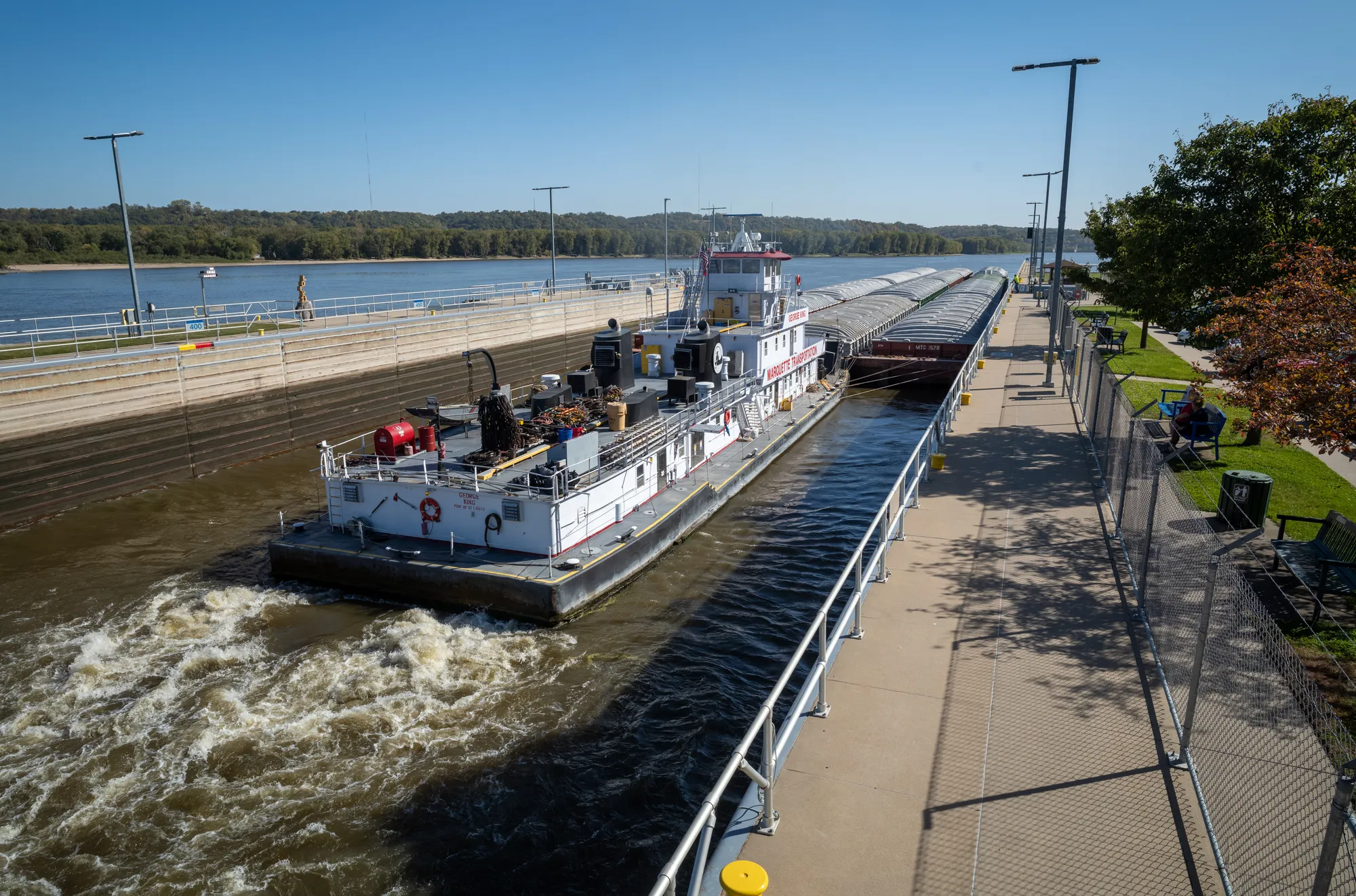
Nearly 60% of exported U.S. soybeans reach their destination by way of the Mississippi River and Gulf ports4. Checkoff-funded research supported deepening the lower Mississippi shipping channel to 50 feet, which lets each ocean vessel carry an additional 500,000 bushels, saving up to 13 cents per bushel and worth a projected $461 million a year to farmers10.
Ports and Export Gateways
As crush capacity expands, soybean meal needs more ways out of the country. Checkoff and STC investment is building meal-export capacity across the Pacific Northwest, the Gulf, the East Coast and the Great Lakes rather than relying on any single route2, 11. One example: the United Soybean Board, the Soy Transportation Coalition and the Iowa, Kansas, Missouri and Nebraska soybean boards jointly committed $275,000 toward research, pre-engineering and design for the Port of Grays Harbor’s Terminal 4 expansion in Washington12. The project reached a major milestone with the grand opening of AGP’s new export facility on July 31, 2026. The facility gives AGP the capability to more than double its annual agricultural commodity export throughput at Grays Harbor, strengthening access to Southeast Asian and other Asia-Pacific markets, and the project added more than 47,000 feet of new rail within the port’s Marine Terminal Complex8.
Another example is a Port Milwaukee expansion by The DeLong Company that lets the Great Lakes port ship soybean meal into Europe and North Africa by way of the St. Lawrence Seaway11.
Digital Connectivity
Precision agriculture depends on moving data as surely as the supply chain depends on moving beans. According to USDA’s August 2025 Technology Use (Farm Computer Usage and Ownership) report, 85% of U.S. farms have internet access, but only 55% have a broadband connection. The same report found that just 22% of farms used precision agriculture practices in 2025, underscoring the opportunity to expand adoption of data-driven technologies14. USB has long pressed the case that reliable, high-speed rural internet is essential infrastructure for modern farming16, 15.
Why Infrastructure Matters
The United States exports roughly a quarter of the grain it produces, including about 47% of the soybean crop3. Every improvement that subtracts cost from moving a bushel makes U.S. soybeans more competitive against South American supply, and every link in the chain — from a county bridge to an ocean terminal — either adds cost or takes it away2.
Which Mode Matters Most? All of Them.
Over a five-year average ending in 2022, trucks accounted for approximately 64% of grain movements, compared with 24% by rail and 13% by barge; percentages may not total 100% due to rounding3. Yet nearly 60% of exported soybeans travel the Mississippi and Gulf route4. Both are true because they count different things: the modal shares count every movement, including the short truck haul from field to elevator, while the river figure counts how exported beans complete the long trip to an ocean vessel. Trucks move the most loads, rivers and rail move the most miles, and no mode substitutes for another3.
Low Water Is a Recurring Risk
Shippers entered the 2026 harvest facing a possible fifth straight year of low water on the Mississippi. On Sept. 3, 2026, the river gauges read 3.5 feet near St. Louis and 2.6 feet near Memphis, forcing barges to carry lighter loads in smaller groups and raising the cost per bushel during the October-through-December export season20. As of Oct. 22, 2026, the river at St. Louis was at its lowest level of the fall and forecast to reach the low-water threshold in early November, with little rain expected through the end of the month19. Rainfall at the Panama Canal has also run well below average, but because soybeans move through the canal’s older locks, where the normal depth limit still applies, shipments are not directly affected unless conditions worsen4.
Rail Consolidation Under Review
Union Pacific and Norfolk Southern have applied to combine. The Surface Transportation Board accepted the railroads’ revised application for consideration on May 28, 2026, then removed the proceeding from abeyance and adopted a procedural schedule on August 186. The railroads target completion in the second half of 2027.
Snapshot
About 25%
Of U.S. grain production is exported
Source: USDA / United Soybean Board
47%
Of the U.S. soybean crop is exported
Source: USDA / United Soybean Board
$461M
Projected annual value to farmers from a 50-foot Mississippi shipping channel
Source: USDA / United Soybean Board
$0.13
Freight savings per bushel from the deepened channel
Source: USDA / United Soybean Board
The Projects Soy Investment Makes Possible
Port of Houston, Texas
The United Soybean Board, the Soy Transportation Coalition, and the Iowa, Kansas, Missouri and Nebraska soybean boards jointly invested $275,000 in pre-engineering and design for The Andersons’ export terminal expansion at the Port of Houston9, 13, which will export 1 million metric tons of soybeans and soybean meal2.
Railroads as Soy Customers
All six Class I railroads have joined Clean Fuels Alliance America, signaling growing interest in biofuels as an alternative to conventional locomotive fuel. This creates an emerging opportunity for soybean oil as a renewable fuel feedstock, positioning the rail industry as both a transporter of soybeans and a potential source of additional demand for soybean oil7.
The Latest in Infrastructure
For fiscal year 2027, USB continues funding research, promotion and education across food, feed, fuel, industrial uses, exports and sustainable production, with infrastructure and connectivity a standing priority17.
Resources
A checkoff-funded coalition working to keep roads, rail lines, and waterways reliable and well maintained.
Covers developments affecting the transport of grain, both in the domestic and international marketplace.
From the field to global markets, see the results of farmer-led checkoff investment in soy research, promotion, and education.
Sources
All links verified November 2026.
- Soy Transportation Coalition (comprised of 15 state soybean boards, the American Soybean Association and the United Soybean Board). soytransportation.org. https://www.soytransportation.org/
- Iowa Soybean Association (funded by the soybean checkoff). Baratta, B. "Investing in Infrastructure From Farm to Port" (Soy Transportation Coalition projects). May 1, 2026. https://www.iasoybeans.com/newsroom/article/isr-may-2026-investing-in-infrastructure-from-farm-to-port
- USDA Agricultural Marketing Service. "Transportation of U.S. Grains: A Modal Share Analysis." https://www.ams.usda.gov/sites/default/files/media/TransportationofUSGrainsModalShare1984_2022.pdf
- Iowa Soybean Association (funded by the soybean checkoff). Baratta, B. "Low Water Threatens Midwest Soybean Shipping." September 3, 2026. https://www.iasoybeans.com/newsroom/article/low-water-threatens-midwest-soybean-shipping
- Soy Transportation Coalition. "Farm to Market: A Soybean’s Journey From Field to Consumer." https://www.soytransportation.org/FarmToMarket/FarmToMarketStudy0816Study.pdf
- Surface Transportation Board. "STB Adopts Procedural Schedule for Consideration of UP-NS Merger; Removes Proceeding From Abeyance." https://www.stb.gov/wp-content/uploads/PR-26-21.pdf
- Clean Fuels Alliance America. "Clean Fuels Conference Outlines Opportunities Ahead." https://www.cleanfuelsconference.org/clean-fuels-conference-outlines-opportunities-ahead/
- Port of Grays Harbor. "Terminal 4 Grand Opening." August 3, 2026. https://www.portofgraysharbor.com/news/t4grandopening
- United Soybean Board, Soy Transportation Coalition, Iowa Soybean Association, Kansas Soybean Commission, Missouri Soybean Merchandising Council and Nebraska Soybean Board. "Soybean Farmers Make Tangible Investments for Tangible Results at Houston Export Terminal." October 2025. https://nebraskasoybeans.org/newsroom/articles-and-press-releases/category/press-release/article/2025/10/soybean-farmers-make-tangible-investments-for-tangible-results-at-houston-export-terminal
- United Soybean Board. "Dredging Project Readies Mississippi River for Efficient Soy Transportation." https://unitedsoybean.org/hopper/dredging-project-readies-mississippi-river-for-efficient-soy-transportation/
- United Soybean Board. "More Options, More Opportunities: Diversifying the Soy Supply Chain." https://unitedsoybean.org/hopper/more-options-more-opportunities-diversifying-the-soy-supply-chain/
- United Soybean Board. "Soy Checkoff Supports Research to Expand Key Soybean Meal Export Infrastructure." https://unitedsoybean.org/hopper/soy-checkoff-supports-research-to-expand-key-soybean-meal-export-infrastructure/
- Missouri Soybeans / Soy Transportation Coalition. "Investing in Infrastructure: Soybean Farmers Provide $1.3 Million Ceremonial Check for Soybean Meal Export Expansion." https://mosoy.org/article/investing-in-infrastructure-soybean-farmers-provide-1-3-million-ceremonial-check-for-soybean-meal-export-expansion/
- USDA National Agricultural Statistics Service. Technology Use (Farm Computer Usage and Ownership). August 2025. https://esmis.nal.usda.gov/sites/default/release-files/h128nd689/bv73dz25x/n8711q81s/fmpc0825.pdf
- Benton Institute for Broadband & Society (funded by the United Soybean Board). Arnold, J. "The Future of American Farming." October 2021. https://www.benton.org/publications/future-american-farming
- United Soybean Board. "The Future of American Farming Demands High-Speed Internet Solutions." Press release, October 27, 2021. https://unitedsoybean.org/hopper/the-future-of-american-farming-demands-high-speed-internet-solutions/
- United Soybean Board. "United Soybean Board Approves FY27 Budget to ‘Sharpen Focus and Maximize Farmer Returns.’" July 24, 2026. https://www.soycheckoff.org/news-and-stories/united-soybean-board-approves-fy27-budget-to-sharpen-focus-and-maximize-farmer-returns
- USDA Agricultural Marketing Service. Grain Transportation Report, April 16, 2026 (BNSF customer-projects highlight). https://www.ams.usda.gov/sites/default/files/media/GTR04162026.pdf
- DTN. "Water Levels on Lower Mississippi River Starting to Run Low Again." October 22, 2026. https://www.dtnpf.com/agriculture/web/ag/news/article/2026/10/22/water-levels-lower-mississippi-river
- U.S. Army Corps of Engineers, Mississippi Valley Division. "Mississippi River Low Water Event Summary," as of September 3, 2026. https://www.mvk-wc.usace.army.mil/mvd/lowwaterupdate.pdf